English
Be curious - All children are exposed to a wide variety of language and the written word through a text-based approach as they develop their skills as articulate and imaginative communicators. Exploring the world of fiction to spark the children’s imaginations and curiosity; as well as, motivating the children to question and investigate the world around them through varying non-fiction texts.
Love learning - Staff provide a rich learning environment reinforced by author and poet visits, to stimulate and support the children’s English journey. Through writing for a variety of purposes, children are given the opportunity to shine as they see themselves as real writers, taking ownership of their writing and developing their skills to organise and plan their writing.
Grow together with respect - Through carefully chosen texts, we inspire the children to appreciate and immerse themselves in different cultures, faiths, and world views. The children are given the opportunity to celebrate each other’s writing and performance poetry throughout the year.
English Purpose of Study
English has a pre-eminent place in education and in society. A high-quality education in English will teach pupils to speak and write fluently so that they can communicate their ideas and emotions to others, and through their reading and listening, others can communicate with them. Through reading in particular, pupils have a chance to develop culturally, emotionally, intellectually, socially and spiritually. Literature, especially, plays a key role in such development. Reading also enables pupils both to acquire knowledge and to build on what they already know. All the skills of language are essential to participating fully as a member of society; pupils who do not learn to speak, read and write fluently and confidently are effectively disenfranchised. - National Curriculum
Reading & Phonics
St. James’ and Ebrington and the NCSF Trust are determined that every pupil will learn to read, regardless of their background, needs, or abilities.
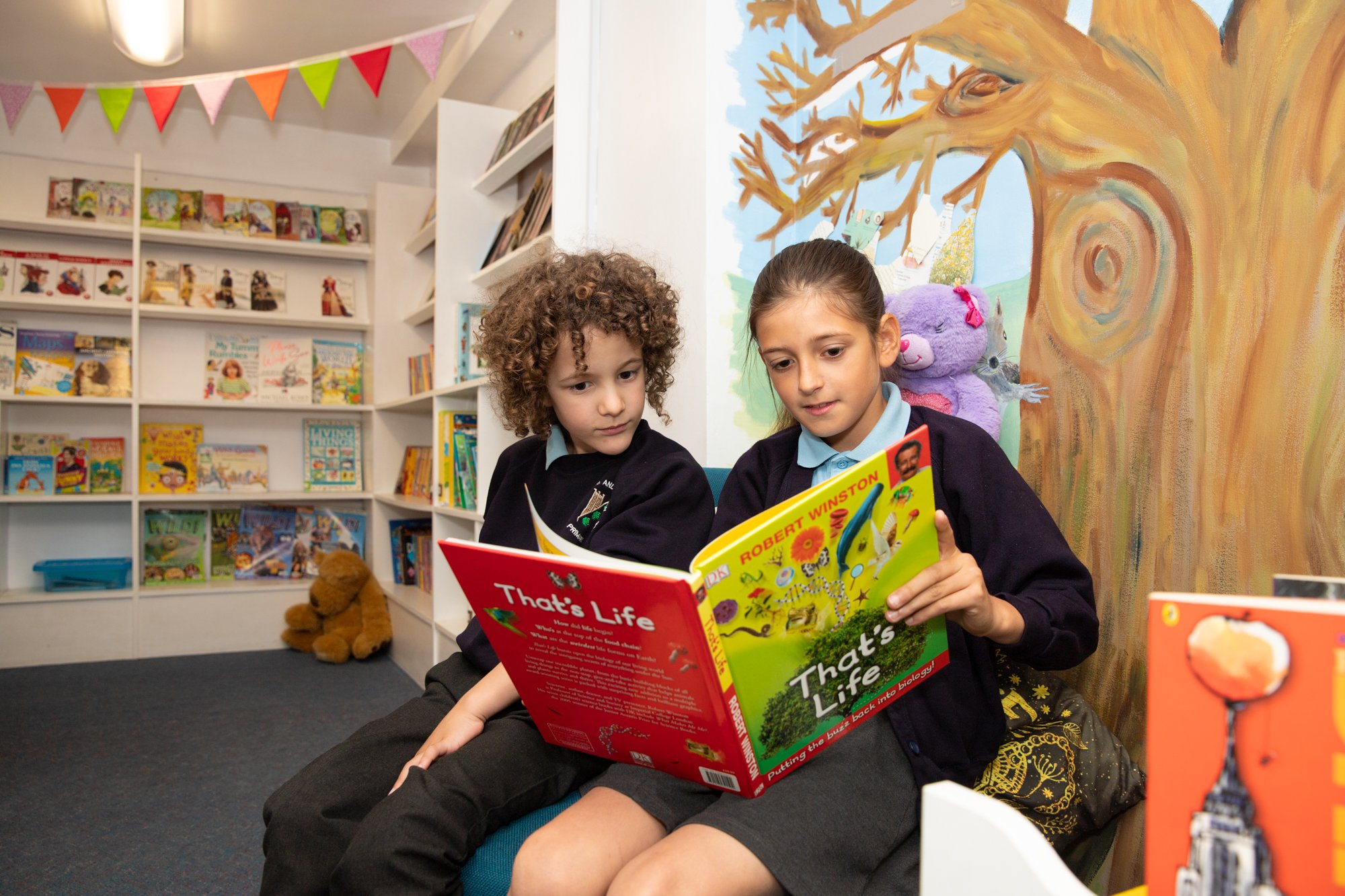
Stories, poems, rhymes, and non-fiction are chosen for reading to develop pupils’ vocabulary, language comprehension, and a love of reading.
A detailed progression of how reading is taught can be found in the reading progression grid.
The reading scheme in our schools follow our phonics teaching sequence from 'Essential Letters and Sounds'. We use colours to distinguish between the different levels of books, which match the phonics phases, some phases are particularly large so there may be more than one colour band focused on the sounds from this stage.
Our books are ordered within each colour band to match the sequence in which phonics sounds have been taught. Children should be able to decode using the phonics they have been taught previously to read their books. If a book contains sounds or ‘harder to read and spell words’ that have not been taught yet there will be a sticker on the front cover that says 'read this book together'. We ask you to support your child/ren to read certain words and sounds that have not been taught yet.
Reading books will be changed once a week, and the specific days will be chosen by each class teacher. The teachers will send home a minimum of two books each time in EYFS and KS1. Books of greater length and content will be changed when required in KS2. We would like you to encourage your child to re-read the books sent home three times. The three stages of reading a book to develop fluent readers are:
Decoding: the process of segmenting words into known sounds and blending them for meaning.
Prosody: reading fluency with appropriate pitch, pace, phrasing, and expression.
Comprehension: taking meaning from the words and storyline.
These steps are sequential and result in the children becoming fluent readers who are able to take meaning from the books they are reading. Fluent reading aids comprehension. In school, your child will be listened to read twice a week in EYFS and KS, and in KS2 once a week. Reading records will be checked by the teaching staff or teaching partners during the week.
Phonics Pronunciation
It is vital that the correct pronunciation is used when blending sounds in words, as this enables the children to hear the words clearly. Use the link below to visit the ELS parent support page. The videos below contain the correct pronunciation for each phase.
Phase 2 Pronunciation Video
Phase 5 Pronunciation Video
Phase 3 Pronunciation Video
Writing
Our English Long Term Plan sets out our Key Texts and genre focus across each term, with grammar and punctuation skills matched so they are taught and revisited both discretely and within a writing context. We have been working on revising our writing within school, using the published document, The Writing Framework, which focuses on the fundamentals such as handwriting and grammar. We like to use a range of texts to inspire the children and their writing.
Spelling
In EYFS and KS1 our spelling teaching is taught through the use of the ELS Phonics Scheme detailed above. Each lesson has a taught session using the ELS powerpoints, which is followed by handwriting and spelling applying their new sound/s each day.
In KS2, we now also use the ELS spelling scheme that builds on the phonics knowledge and spellings developed in KS1. This is taught as discrete lessons.

Handwriting
At St. James’ and Ebrington, we use the NCSF Handwriting Progression to teach handwriting. The children start mark-making in EYFS and are taught to form letters in print form alongside their phonics sounds for the week. Children progress to pre-cursive in KS1 and continuous un-joined cursive, before joined cursive when they are ready to do so. We take pride in our presentation and being respectful of our resources including exercise books. ‘Wow’ work is celebrated for varying reasons including progress and perseverance in presentation, and handwriting in our Friday ‘Gold Book Worship’ and on our ‘Wow Work Walls in our classrooms’.